

Every mission-driven organization starts with a clear purpose. A nonprofit is founded to serve a specific community. A ministry is planted to meet a specific spiritual need. A faith-based institution opens its doors with a specific calling in mind. But purpose, left unattended, has a way of quietly slipping. That slow, often invisible shift away from an organization’s founding purpose is called mission drift. It’s one of the most common reasons mission-driven organizations lose their effectiveness, their culture, and eventually their credibility.
Mission drift rarely happens overnight. It happens one reasonable-sounding decision at a time.
What Is Mission Drift, Exactly?
Mission drift is the gradual disconnect between what an organization says it exists to do and what it actually spends its time, money, and energy doing. It’s different from strategic evolution, where an organization intentionally adapts its methods while staying anchored to its purpose. Drift is unintentional. It happens when leaders stop asking “does this serve our mission?” and start asking only “does this keep the lights on?”
A nonprofit founded to serve low-income families might slowly shift toward programs that are easier to fund, even if they serve a different population. A ministry founded on discipleship might drift toward attendance numbers and building campaigns. In both cases, the organization can look successful from the outside — growing budgets, growing staff, growing visibility, while quietly becoming unrecognizable to the people who founded it.
Why Mission Drift Happens
Mission drift is almost never caused by bad intentions. It’s caused by pressure. Common drivers include:
- Funding pressure. Grants and donors often come with strings attached, and organizations start shaping programs around what’s fundable rather than what’s needed.
- Growth pressure. As organizations scale, new leaders and staff join who weren’t present for the founding vision and interpret the mission through their own lens.
- Metrics pressure. When success is measured only by numbers —donors, attendance, revenue—leaders naturally start optimizing for what’s measured, even at the expense of what matters most.
- Leadership turnover. Every time leadership changes hands, there’s a risk that the new leader’s priorities subtly replace the founding mission rather than serve it.
None of these pressures are avoidable. What separates organizations that stay mission-aligned from those that drift is whether leadership actively guards against it.
Warning Signs of Mission Drift
- Staff and volunteers struggle to explain, in one sentence, what the organization exists to do
- Programs have expanded in ways no one can clearly connect back to the founding mission
- Decisions are increasingly justified by “this is what funders want” rather than “this is what our mission requires”
- Culture has shifted from purpose-driven to metrics-driven
- Long-tenured staff or founding supporters express that “this doesn’t feel like the organization we joined”
If even one or two of these feel familiar, it’s worth pausing to take a hard look.
How to Prevent Mission Drift
1. Revisit your mission statement — and mean it. Don’t treat your mission statement as a plaque on the wall. Use it as a working filter for every major decision: does this program, partnership, or funding source serve our actual mission, or just our budget?
2. Build accountability structures, not just aspirations. Good intentions aren’t enough. Organizations that stay aligned build real structures — board oversight, leadership check-ins, values-based decision frameworks — that make mission alignment something the organization actively practices, not just believes in.
3. Protect founder-level knowledge as the organization grows. As new leaders and staff join, mission drift often starts simply because the founding story and “why” behind the organization was never institutionalized. Write it down. Teach it. Repeat it often.
4. Separate what’s measurable from what matters. Metrics are useful, but they aren’t the mission. Leaders who lead only by the numbers eventually optimize their organization into something the founders wouldn’t recognize.
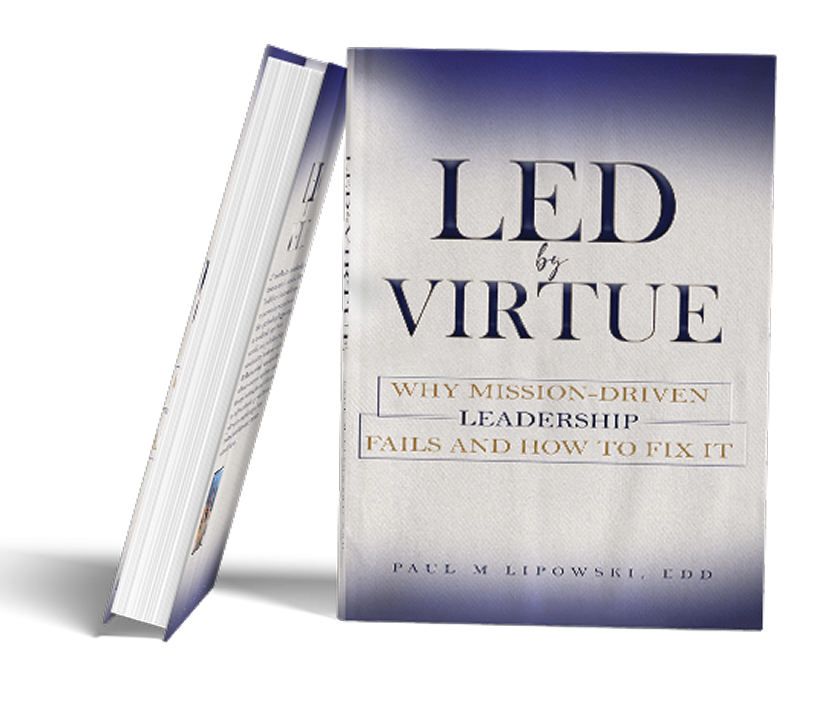
5. Lead with character, not just strategy. This is the core argument at the heart of Led by Virtue: most leadership advice focuses on strategy, performance, and metrics — but mission-driven organizations don’t drift because their strategy was wrong. They drift because leadership stopped being anchored in character and integrity. Strategy tells you how to grow. Virtue tells you whether you should.
The Real Fix Is Leadership, Not Just Policy
You can write the best mission statement in the world and still drift if the people leading the organization aren’t personally anchored to it. That’s why preventing mission drift isn’t ultimately a policy problem — it’s a leadership problem.
Led by Virtue: Why Mission-Driven Leadership Fails and How to Fix It, by Paul Lipowski, was written specifically for leaders navigating this exact challenge — executives, nonprofit leaders, ministry leaders, and faith-based institutions trying to close the gap between their stated mission and their daily reality. The book offers practical frameworks for staying anchored to character and purpose, even under the funding, growth, and metrics pressures that cause most organizations to drift in the first place.
If your organization has started to feel like it’s drifting from what it was built to do, the first step isn’t a new strategic plan — it’s a hard, honest look at the leadership culture driving your decisions.