
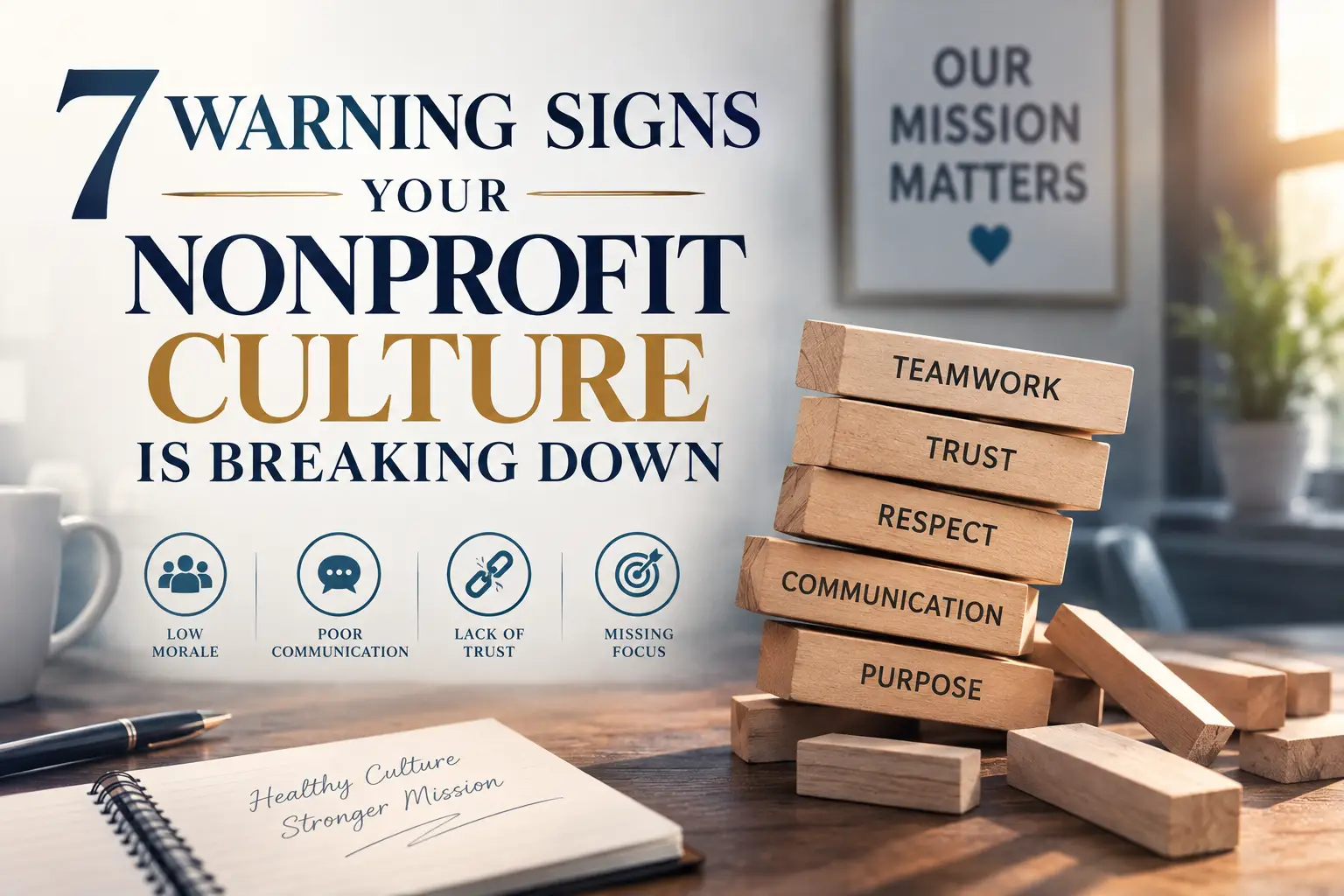
Culture is one of those things every leader talks about but few actually measure, until it’s already a problem. In nonprofits, ministries, and faith-based organizations, culture breakdown is especially dangerous because these organizations run on something a paycheck can’t fully replace: shared purpose. When that purpose starts to erode, it rarely announces itself with a dramatic event. It shows up first in small, easy-to-explain-away signals.
Here are seven of the clearest early warning signs that a nonprofit or ministry culture is starting to break down, and what leaders can do about it before it becomes a full-blown crisis.
1. High Turnover Among Your Best People
Every organization loses staff. But when your most mission-aligned, highest-performing people are the ones leaving first, that’s not a hiring problem, it’s a culture problem. Talented, values-driven people are usually the first to notice when an organization’s stated mission and its lived reality stop matching, and they’re often the first to leave because of it.
2. A Growing Gap Between What Leadership Says and What Leadership Does
Culture isn’t built by mission statements, it’s built by what leadership actually rewards, tolerates, and models day to day. When staff start noticing a consistent gap between the values printed on the website and the behavior modeled by leadership, trust erodes quickly, even if no one says it out loud.
3. Silence in Meetings
Healthy organizational cultures have disagreement. When meetings become unusually quiet, when staff stop offering pushback, new ideas, or honest concerns, it’s rarely because everyone suddenly agrees. It’s usually because people have learned that speaking up isn’t safe or doesn’t matter.
4. Accountability Only Flows Downward
In a healthy culture, accountability applies at every level, including leadership. In a breaking-down culture, accountability becomes something leadership enforces on staff but rarely applies to itself. Over time, this double standard is one of the fastest ways to destroy trust in an organization built around a shared mission.
5. Burnout Is Treated as a Personal Problem, Not an Organizational One
Some level of stress is normal in mission-driven work. But when burnout becomes widespread and leadership’s response is centered on individual resilience, “self-care,” “just push through”, rather than examining whether the organization’s culture or workload is unsustainable, it’s a sign the culture has stopped serving the people carrying the mission.
6. Decisions Are Justified by Funding, Not Mission
Watch how decisions get explained internally. In a healthy culture, decisions get framed around mission impact. In a breaking-down culture, they increasingly get framed around what funders, donors, or the budget require, even when that reasoning quietly contradicts the organization’s stated purpose. This is often an early symptom of mission drift.
7. New Hires Struggle to Understand “How Things Really Work”
Every organization has an official culture (what’s written down) and a real culture (what actually happens). When new employees consistently express confusion between the two, “I thought this place worked differently”, it’s a strong sign the gap between stated values and lived culture has grown wide enough to notice from the outside.
Why These Signs Get Missed
Most leaders aren’t ignoring culture on purpose. They’re simply focused on the metrics that are easiest to track, budgets, program numbers, donor growth, while culture, which is harder to measure, quietly slips down the priority list. By the time culture problems show up in something measurable, like turnover or falling donor trust, the underlying issue has usually been building for a long time.
How Leaders Can Rebuild a Breaking-Down Culture
Start with honest diagnosis, not defensiveness. Ask staff directly, and anonymously if needed, where they see gaps between stated values and daily reality.
Hold leadership to the same standard as everyone else. Accountability that only flows downward will never rebuild trust. Leaders have to be willing to be corrected too.
Reconnect decisions to mission, out loud. When leadership explicitly explains why a decision serves the mission, not just the budget, it rebuilds the sense of shared purpose that healthy culture depends on.
Lead with character, not just competence. Skilled leaders can still preside over a broken culture if character and integrity aren’t the foundation of how they lead. Culture follows character far more reliably than it follows strategy.
This Is the Exact Problem Led by Virtue Was Written to Solve
Led by Virtue: Why Mission-Driven Leadership Fails and How to Fix It, by Paul Lipowski, dives deep into why mission-driven organizations experience exactly this kind of culture breakdown and, more importantly, what leaders can practically do to close the gap between mission and reality. Drawing on real leadership experience with nonprofits, ministries, and faith-based institutions, the book offers frameworks for building the kind of accountable, values-first culture that doesn’t just survive pressure, but grows stronger because of it.
If any of these seven signs feel familiar in your organization, the good news is that culture breakdown is reversible, but only if leadership is willing to look honestly at where character, not just strategy, needs to be rebuilt first.