
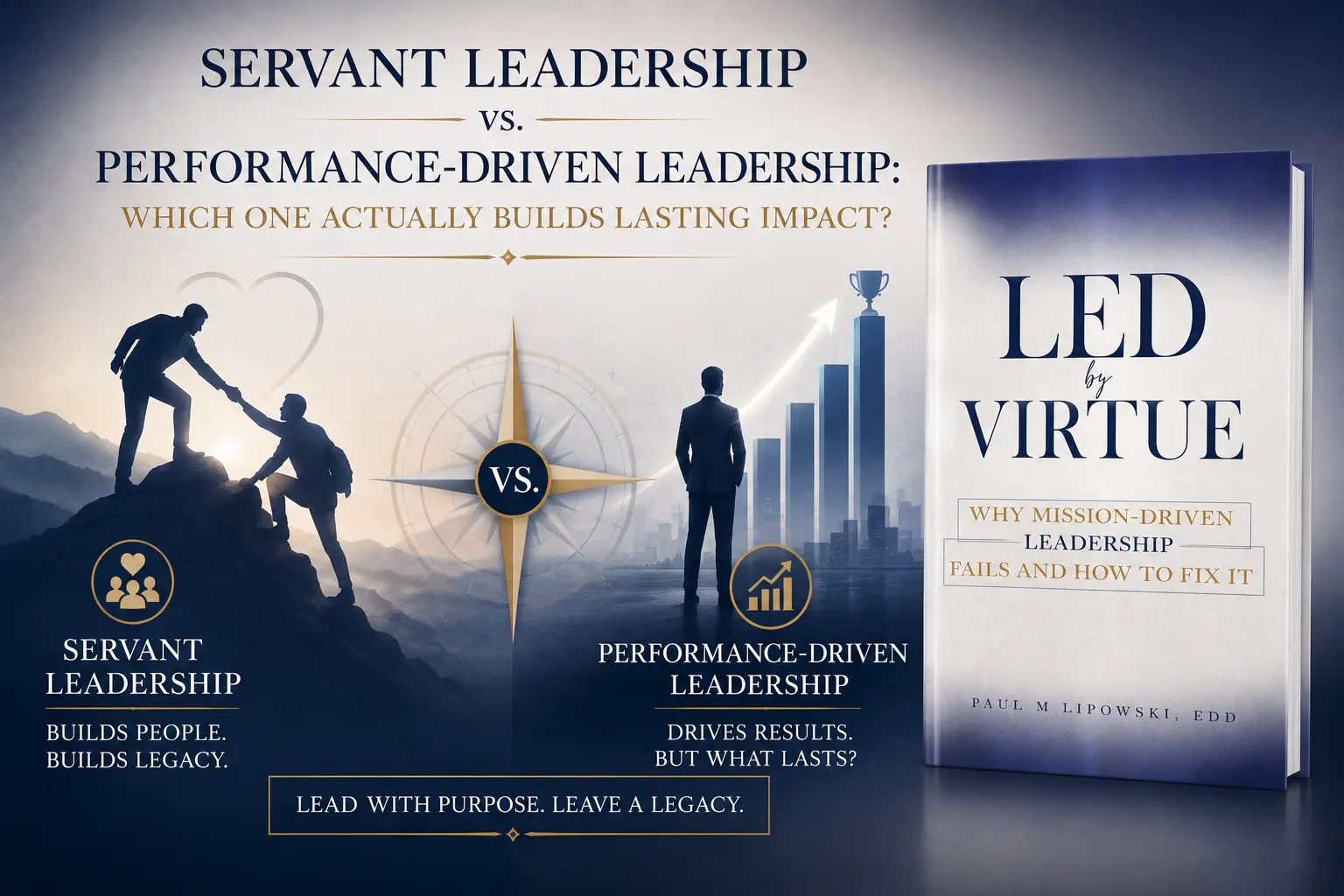
Walk into almost any leadership conference and you’ll hear the same language: KPIs, growth targets, performance metrics, ROI. This is performance-driven leadership — a model borrowed heavily from the corporate world, where success is defined primarily by measurable output. It’s not a bad model. It’s just an incomplete one, especially for mission-driven organizations like nonprofits, ministries, and faith-based institutions, where the “product” isn’t just a number on a dashboard — it’s people, communities, and a mission that can’t be fully captured in a spreadsheet.
The alternative — and the model at the heart of Led by Virtue — is servant leadership: a leadership philosophy built on character, service, and integrity rather than metrics alone.
What Is Servant Leadership?
Servant leadership flips the traditional leadership hierarchy. Instead of leading by directing people toward outcomes the leader wants, servant leaders lead by asking what their people and their mission actually need — then serving that need first. The leader’s authority comes not from a title, but from trust earned through consistent character.
This doesn’t mean servant leaders ignore results. It means results are treated as the outcome of healthy leadership, not the definition of it.
What Is Performance-Driven Leadership?
Performance-driven leadership treats measurable output as the primary indicator of leadership success: revenue, donor growth, attendance, program numbers. It’s efficient, easy to report on, and often exactly what boards and funders ask to see. The risk is that when performance becomes the only lens, leaders start optimizing for what’s easy to measure instead of what actually matters — and culture, trust, and mission alignment quietly erode in the process.
The Core Difference
| Servant Leadership | Performance-Driven Leadership | |
|---|---|---|
| Primary question | “What does my team/mission need?” | “What does the dashboard show?” |
| Source of authority | Trust and character | Title and results |
| Risk of failure | Slower short-term growth | Culture breakdown, burnout, mission drift |
| What it protects | People and purpose | Metrics and output |
Neither model is inherently “wrong.” The problem is that most leadership training today teaches performance-driven leadership almost exclusively — leaving leaders with a full toolkit for hitting numbers and almost no toolkit for building the character-based culture that sustains an organization long-term.
Why This Matters More in Mission-Driven Organizations
A for-profit company can, to some extent, survive a purely performance-driven culture as long as revenue keeps climbing. Mission-driven organizations don’t have that luxury. Nonprofits, ministries, and faith-based institutions depend on trust — from donors, from volunteers, from the communities they serve, from their own staff. When leadership optimizes purely for performance, that trust erodes long before the numbers do, and by the time it shows up on a dashboard, real damage has usually already been done.
This is the exact tension Led by Virtue addresses: mission-driven leadership fails not because leaders lack strategy, but because strategy without character eventually breaks the culture it was meant to protect.
Signs Your Organization Has Tilted Too Far Toward Performance
- Leaders are praised primarily for hitting numbers, rarely for how they treat people along the way
- Staff describe leadership as “results-focused” but not “people-focused”
- Ethical shortcuts get quietly excused because “the numbers were good this quarter”
- Burnout is common, but rarely addressed because output hasn’t dropped — yet
How to Bring Servant Leadership Back Into a Performance-Driven Culture
1. Redefine what “success” means in leadership evaluations. Include character-based measures — how leaders treat their teams, how they handle setbacks, whether they model the organization’s stated values — alongside performance metrics.
2. Make integrity a leadership requirement, not a bonus quality. Organizations that talk about integrity as a “nice to have” almost always end up compromising on it under pressure. Integrity has to be treated as non-negotiable.
3. Slow down high-stakes decisions. Performance-driven cultures often move fast and skip the harder character-based questions. Building in a pause — “does this decision serve our mission and our people, not just our numbers?” — protects against long-term damage.
4. Study leaders who model both. The best mission-driven leaders don’t reject performance — they refuse to let performance override character. Learning from real frameworks for balancing both is far more useful than choosing one extreme or the other.
A Practical Framework for Leading Both Ways
Led by Virtue: Why Mission-Driven Leadership Fails and How to Fix It was written for leaders trying to hold both truths at once — that results matter, and that character has to come first. Paul Lipowski offers practical tools for building the kind of accountability, culture, and alignment that lets mission-driven organizations perform well without sacrificing the values that made them worth building in the first place.
If your organization has quietly become more performance-driven than mission-driven, the fix isn’t to abandon results — it’s to lead the pursuit of those results with character back in the driver’s seat.